
My book review of 11/22/63 by Stephen King is now live at Lit Reactor
Posted on November 19, 2011 Leave a Comment

My review of 11/22/63 is now live at LitReactor and I think it’s Stephen King’s best book in awhile. You don’t have to be a fan of JFK and/or conspiracy theories in order to dig this book. And the time travel aspects are certainly a part of this story, but really, it’s the way that King creates the communities that he builds, develops his characters, and shows us how our decisions effect our futures (and the futures of those around us) that make this his best book in a long time. Read the full review for more information.

Second Storyville column is up at Lit Reactor
Posted on November 17, 2011 Leave a Comment


My second column is now up at Litreactor.com, and it talks about how to write a cover letter, your bio, and the ways that you can stand out when you submit your stories to editors at magazines and journals around the world. Hope it helps you out a little bit. More columns and review to come.
My review of Shannon Cain’s The Necessity of Certain Behaviors is live at The Nervous Breakdown
Posted on November 17, 2011 Leave a Comment

My review of Shannon Cain’s collection of dark, sexy, humorous stories is live up at The Nervous Breakdown. This book was the winner of the 2011 Drue Heinz prize, which yielded us the fantastic The Physics of Imaginary Objects by Tina May Hall last year. Shannon really put together a compelling book, one that should definitely be on your list of titles “to-read.”
New Column – Storyville up at Litreactor.com
Posted on October 26, 2011 5 Comments
Litreactor.com has launched, and man is this site taking off. It’s an offshoot of The Cult, taking all of the publishing, craft, and literature conversations as well as workshops, classes, lectures, reviews and columns away from what was essentially the Chuck Palahniuk fan club, and moving it all to a new base.
I’m thrilled that I will be writing a column, called Storyville, and my first column is now up, about Finding Your Voice. I’ll have a column every month, maybe more often. I’ll also do book reviews now and then, and maybe some interviews sporadically as well.
The people in charge of this, Kirk Clawes, Dennis Widmyer, Joshua Chaplinsky, Mark Vanderpool and Phil Jourdan, they’re amazing people, very hard working, and so smart. I’m honored to be a part of it. And the writers? Wow, where to even start, so much talent joining me, Brandon Tietz, Erin Reel, Keith Rawson, Kasey Carpenter, Rob W. Hart, really you just need to head over and check it all out. So much to absorb.
Dueling Columns 3 – MFA Programs: Yes or No, with Caleb J. Ross
Posted on October 12, 2011 1 Comment
TODAY AS PART OF THE EPIC CALEB J. ROSS STRANGER WILL TOUR, CALEB AND I WILL DEBATE MFA PROGRAMS. HE WILL TAKE THE CON AND I WILL TAKE THE PRO. ENJOY. OH, AND PICK UP HIS BOOK, HE’S SO TALENTED. I’M HONORED TO BE ON THE SAME LABEL AS CALEB.
Dueling Columns – To MFA or not to MFA
This is a guest post by CalebJRoss (also known as Caleb Ross, to people who hate Js) as part of his Stranger Will Tour for Strange blog tour. He will be guest-posting beginning with the release of his novel Stranger Will in March 2011 to the release of his second novel, I Didn’t Mean to Be Kevin and novella, As a Machine and Parts, in November 2011. If you have connections to a lit blog of any type, professional journal or personal site, please contacthim. To be a groupie and follow this tour,subscribe to the CalebJRossblogRSSfeed. Follow him on Twitter: @calebjross.com. Friend him on Facebook: Facebook.com/rosscaleb
AGAINST MFA PROGRAMS – Caleb
In the third installment of Richard Thomas’s Dueling Columns series, he and I stake our positions on the idea of an MFA. At this point in my life, I land in the “not to MFA” group.
First, a bit of context. Richard has an undergrad degree in Advertising and Communications with a minor in Psychology. He is currently pursuing an MFA. I have an undergrad degree in English Lit with a minor in creative writing. I am not currently pursuing an MFA. Why is this important? To show that I am coming at this question of education with a different educational history than Richard. Furthermore, as far as I am aware, Richard’s goal is to teach creative writing at a college level. An MFA is a requirement to do so. I do not want to teach. So I must argue this as though he and I are both looking at the MFA as a way to develop one’s creative writing abilities, not as a way to ensure a career in academia. If you want to be a professor, you can stop reading now; there really is no pro vs con debate.
So, with all of those qualifiers out of the way, let’s get into the meat of the duel.
Cost analysis
At its core, an MFA program is an extension of the traditional 4-year undergrad program, and in being so carries financial and structure burdens similar to that of an undergrad program. What we are looking at then is cost. Basically, the cost of an MFA includes two things: connections and time. You’ll meet many famous writers and you’ll be forced to write. Both of these things are necessary for a serious writer. But, neither of these things is the sole intellectual property of the MFA program. For any serious writer, MFA or no, connections and productivity are things that will come as a result of dedication. Using my experience as an example (a sample size of one, I know, dangerous), within the first two years of post-undergrad life (2005-2007), I completed three novel-length manuscripts (two of which are to be published in 2011), became an editor at Outsider Writers Collective (where I’ve interacted with some of the best independent writers around), contributed book reviews to a variety of online zines, participated in Write Club (which surpassed my undergrad workshops in many ways, but not all ways), and met Richard Thomas (which ultimately led to my book being published by Otherworld Publications). Roxanne Gay, in ablogpostatHTMLGiant about this very topic of MFA, sums up my opinion nicely: “I do believe one should never pay for graduate school but that a graduate education is awesome.”
I feel any higher education in the liberal arts should focus as much on the how tos as the whys. From what I know of MFAs, there is a large why focus, specifically in regards to pedagogy, which is great. A good writer can write. A great writer can think. But again, if you have the passion to be a great writer, you’ll seek out the whys on your own. Does this mean an MFA is essentially a writing desk with a $30,000 gun to your head? Yeah.
Craft analysis
I don’t believe that the MFA program offers anything in terms of learning how to tell a story that an adequate undergrad program can’t offer. Continuing with my personal experience as an example, it may be that my undergrad experience was so great that I gained what I would consider the equivalent of an MFA (in terms of education, not in terms of papered credentials). My professor, Amy Sage Webb, continues to be one of my strongest supporters, and without her I may very well have moved right into an MFA program after undergrad. Though ironically enough Amy pushed me almost daily to pursue graduate school; perhaps in a strange Socratic way. What I learned as an undergrad, when weighing the pros/cons of grad school, is what Lincoln Michel, Master of Fine Arts and co-editor of Gigantic Magazine says in his reaction piece to ElifBatuman’santi–MFAreview “bookreview”: “Studyingandcritiquinganartformisn’tthesameaspracticingit.” MFA programs train students to study and critique writing. The craft itself can be learned elsewhere. Sure, there’s a thesis/novel to be written during a two-year program, but any writer worth his own cramped knuckles will produce a manuscript in two years.
I have to end by admitting that this opinion isn’t one I intend to keep, unchanged, for the rest of my life. I may want to teach one day. In fact, I’d be surprised if I didn’t attempt to teach someday. At that time, I’ll be in line for my MFA. But professorial aspirations aside, MFA’s just aren’t worth the time and financial investment.
Takeaways:
- An MFA may guide a student more directly than self-navigation through the vast land of education, but at a great financial cost
- An MFA is necessary for teaching at a college. I think this is the case all around, but correct me if I am wrong.
- Given the right undergrad program, one can learn just as much in terms of how tos and whys without pursuing an MFA.
- If you want to be a great writer you will be a great writer; no MFA necessary
- The internet makes it almost impossible not to network with established writers; no MFA program necessary.
*********************************
FOR MFA PROGRAMS – Richard
As Caleb mentioned in his column, if you want to teach at the university level, then you must get an MFA. And at many fine universities, you may need a PhD these days as well. In addition to that, most schools want you to have at least one published novel or short story collection (the bigger and better the press, the greater the recognition) as well as many stories published in the best journals and magazines in the country, and some teaching experience as well. But we’re not talking about that today, we’re talking about everything else that comes with your MFA experience and why you should spend the time, money, and effort to get an MFA. Here’s what I think about it all.
Forced Reading and Analysis
I know it seems like a horrible thing to say, but if you have deadlines, and if you’re spending money on something, you will most likely pay attention and work hard at it. If you have to turn in a short story, an annotation (based on a novel or collection that you had to read first, of course) by the end of each month, you are going to do it. I certainly do write stories on my own, and without deadlines, but I can honestly say that having a word count, a book (or two) to read each month, it kept me producing. My low-res MFA program down at Murray State University in Murray, Kentucky (where I’m just finishing up my studies) really pushed me—to write, to read and to analyze. I doubt I would have done this on my own. Maybe I would have, but the forced requirements left me no room to play around. And since I did pay for my MFA, no grants, scholarships or other aid, I took it seriously.
Working Outside of Your Comfort Zone
I can honestly say that there are many authors that I definitely would not have read if it wasn’t for my MFA program. While we did have the ability to pick our books to read over the course of each semester (7-11 titles), some of what my professors asked me to read were not up for discussion: the Norton Anthology of Short Fiction, The New Yorker, and the Best American Short Stories anthology series. I read a wide range of authors that really helped me to see what the literary landscape is like today, as well as in the past hundred years or so. For our fiction genre lectures as well, we read Poe, Murakami, McCarthy, and many other authors that I either didn’t know very well, had read some of their work, or were totally new to me. Since my undergraduate studies at Bradley University were in Advertising/Communication, I was lacking in my literary studies. Between the work I found on my own (Holly Goddard Jones, Mary Gaitskill, Flannery O’Connor, Ron Rash), the work that was assigned, and the authors that I already loved, and decided to re-read or dig into deeper, the scope of my reading and analysis was much wider than I would have assigned to myself on the outside, in the real world. That’s something to consider.
Mentors, Professors and Peers
I studied under Lynn Pruett my first semester and she really helped me to hone in on the authors I already enjoyed and to write the first half of my second neo-noir novel (Disintegration) which I’m shopping now. But it was studying under Dale Ray Phillips (nominated for a Pulitzer Prize) that I really pushed myself. Or maybe I should say—was pushed. DRP got me away from the crutches and tricks that I used in my genre writing, where I often leaned heavily on sex and violence and the occasional twist ending, exploring fantasy, horror, crime, neo-noir, you name it. He wanted straight literary stories where nobody died at the end. What was his big line to me? Leave the slow reveal to the strippers. It was hard—really hard. I had to focus on the story, and the classic structure of a story, find my narrative hook, explore the conflicts in the lives of my characters, and bring it to a satisfying end. Above and beyond these two professors, I talked to many talented authors, teachers, and guest authors, who really enlightened me on so many subjects, as well as a gifted group of fellow fiction writers, poets, and essayists.
Guest Authors
I was talking to some author friends at a recent residency I was awarded (Writers in the Heartland) and I mentioned to the poet that I was constantly surprised by how much I enjoyed the guest poets at MSU. The same goes for a lot of the non-fiction authors. I was always surprised at how talented all of the guests were, from fiction writer Richard Bausch making me cry with his emotional truths, and essayist Heather Sellers making me laugh with her stories of facial blindness, to poets Linda Bierds and Alice Friman showing me the power of poetry, and journalist Nick Reding exploring the haunting world of crystal meth and addiction. The readings blew me away and the craft lectures were always enlightening and educational.
Conclusion
Do you need an MFA to write? No, you do not. You are certainly, if you are driven enough, capable of reading extensively, publishing widely, and studying on your own. But if you want to work with published authors in an environment with your peers, and get that extra push you may need to read, write and publish, then an MFA is a great place to study and create. I really enjoyed my time at MSU, and this program is still a relatively unknown and emerging program. If you can get into a top program, and get some financial aid, and especially if you are still unencumbered by a wife or husband and a household full of children, then I can’t think of a better way to massage your voice and grow as an author.

Thanks, Caleb for being a guest today. Pick up ^ this book today, people.
6th place finish at the Zouch LIT BITS Fiction Contest
Posted on October 12, 2011 Leave a Comment

I’m thrilled to announce that my story “Charlotte Sometimes” came in SIXTH place over at the Zouch Magazine LIT BIT Fiction Contest. My micro-fiction with the Cure title will be up live at Zouch in the near future. Also, my buddy and fellow Write Club member Craig Wallwork came in EIGHTH. Big fan of his work. Not bad for 200+ entries, right? Thanks, Zouch!
My story “Kiss Off” is now live at Emprise Review.
Posted on September 19, 2011 2 Comments

My story “Kiss Off” is now live at Emprise Review.
How do these things happen, I often wonder. Maybe I was issued a challenge, maybe I was just listening to Pandora one day and an old Violent Femmes song came on and I thought “Damn, this is a good song.” As I nodded my head and started to recite the lyrics, these classic alternative indie lyrics from many years ago, I also thought, “This would make a good story.” Here are the original lyrics, in their entirety with the part that I stole from in bold:
I need someone a person to talk to
Someone who’d care to love
Could it be you could it be you
Situation gets rough then I start to panic
It’s not enough it’s just a habit
Hey kid you’re sick well darling this is it
You can all just kiss off into the air
Behind my back I can see them stare
They’ll hurt me bad but I won’t mind
They’ll hurt me bad they do it all the time
Yeah yeah they do it all the time
Yeah yeah they do it all the time
Yeah yeah they do it all the time
Yeah yeah they do it all the time
I hope you know this will go down
On your permanent record
Oh yeah well don’t get so distressed
Did I happen to mention that I’m impressed
I take one one one cause you left me and
Two two two for my family and
3 3 3 for my heartache and
4 4 4 for my headaches and
5 5 5 for my lonely and
6 6 6 for my sorrow and
7 7 for no tomorrow and
8 8 I forget what 8 was for and
9 9 9 for a lost god and
10 10 10 10 for everything everything everything everything
You can all just kiss off into the air
Behind my back I can see them stare
They’ll hurt me bad but I won’t mind
They’ll hurt me bad they do it all the time
Yeah yeah,yeah they do it all the time
Yeah yeah,yeah they do it all the time
Do it all the time
Do it all the time
Do it all the time time time
Yeah yeah they do it all the time
This whole song resonates with me, it always has. It’s a story of angst, of the world not being fair, of the bullshit and violence and randomness that not only shadows our youth, but the adult world as well. The opening lines of this song, they haunt me to this day. “I need someone, a person to talk to, someone who’d care to love. Could it be you?” Isn’t that what we all say, we all want? Sure it is.
So, I took the ten parts and tried to imagine a scene where a man who is falling apart, he says these things to himself, he is talking to himself. He’s talking to the world. He has talked himself into ending it all, but maybe, at the end of it, when the lights are fading and he feels that maybe there is something left to cling to, he tries to change his situation. He won’t be the victim yet once again. But, as it often is in life, maybe it’s too late. I hope you enjoy “Kiss Off.”
Thank you, Amber Sparks for always supporting my work and for taking this story at Emprise Review. If you didn’t know it, I’ll tell you now that not only is Amber a great editor, but one hell of an author as well. Also, thanks to Patrick McAllaster for his excellent editing too, he caught some things that got by me.
There is more excellent fiction in this issue by Amye Archer, Joe Kapitan, Jon Morgan Davies, Marko Fong, Steven R. Gowin, Todd McKie, Brian Mihok, Garrett Socol, and Angela Woodward. Check it out when you get a second.
My review of Crimes in Southern Indiana by Frank Bill is now live up at The Nervous Breakdown.
Posted on September 16, 2011 Leave a Comment
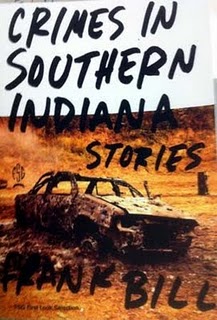
Maybe you’ve never heard of Frank Bill. Well, open them damn ears, son. I just went to the release party for Crimes in Southern Indiana down in Corydon, Indiana. Yes, I dragged Chris Deal, Livius Nedin and Robb Olson with me. Yes, there was a fifty foot sign that said HELL IS REAL about halfway down. YES, it was pouring rain as we entered Corydon, not a cloud in the sky, exploded dear parts on the side of the road. I can’t say I was shocked. Frank is a great guy, and one hell of an author. This is a visceral collection of gritty stories. And anybody that can pull Donald Ray Pollock, Matthew McBride, Scott Phillips, Jedediah Ayers and Kyle Minor to his reading, well, he must be doing something right. Read my review over at TNB for all of the details.
Cemetery Dance – stories, contests and things that go bump in the night.
Posted on September 14, 2011 Leave a Comment

So, my buddies over at Cemetery Dance are having a contest. They’re giving away a lot of books. Why not help them get the word out about one of my favorite presses. Sure, I published a story “Stillness” in Shivers VI with some hacks named Stephen King and Peter Straub. So what? I’ve been buying books from these guys for years – beautiful signed, limited editions. Magazines with work by some of the best in the business. And they couldn’t be nicer people. Brian James Freeman has been a great friend, supporter of my work, and generous editor and author. Richard Chizmar is a fantastic editor with a real eye for talent (see what I did there?). Norman Prentiss is a great editor and writer as well. Support one of the best indie horror presses around.
My review of Short Bus by Brian Allen Carr is live at The Nervous Breakdown.
Posted on September 6, 2011 Leave a Comment

My review of the short story collection, Short Bus by Brian Allen Carr is now live at The Nervous Breakdown. This is a wild bunch of stories set along the Texas and Mexico border. Carr takes the essence of wanderlust mixes it with the desert heat and tosses in a bit of failure with just a pinch of heartbreak to create a compelling volume of work. Head over to The Nervous Breakdown for the full review. Good stuff.
 - Richard Thomas -